
Trading strategies
Trading strategies for beginners
How to start off right: what to learn first, why one method beats ten, and which mistakes drain accounts early on. No promises, no signals — just the steps that matter at the start of the road.
Published Jun 15, 2026 · Updated Jun 15, 2026 · 8 min read

Starting point
There is no "perfect strategy for beginners"
If you've ended up here, you're probably looking for a strategy that "works" — a clear set of rules to follow and be done with it. That's the normal reaction of anyone starting out. The problem is that, early on, the outcome isn't decided by the strategy but by what happens around it: how much you risk, how much you practice, and whether you can stick to a plan without changing it after the first loss.
This page won't give you "the best strategy," because there is no universal one. It shows you how a beginner who wants to survive in the market thinks: what to put in place before any method, how to choose a first approach, and which mistakes cost you the most. The rest — technical analysis, indicators, reading the chart — you'll go deeper into on the dedicated pages, once you have the basics down.
Any method, however simple or complicated, has periods when it works and periods when it doesn't. A beginner who jumps from one strategy to another is chasing something that doesn't exist: a method that always wins. A simple method, well understood and applied consistently, will get you further than a complex one applied haphazardly.
The right question isn't "which is the best strategy," but "how do I choose a method I can actually apply consistently."
Three things before any strategy
Before you think about any particular method, three things need to be in place. Without them, any strategy is just noise. These aren't options to choose from — they're the foundation.
Risk management
Decide upfront how much you're willing to lose on a single position and don't exceed that amount. It sounds boring, but this is exactly where accounts are lost or preserved. The goal early on isn't to make a lot — it's to stay in the game long enough to learn.
See the pageDemo account
A demo account gives you the real market, but with virtual money. It's where you turn a method from theory into reflex, without risking anything. Use it until you apply the rules without thinking about every step.
Open a demo accountTrading journal
Write down every position: why you entered, what you felt, how it turned out. After a few dozen entries you'll spot patterns you'd otherwise miss — and find out what works for you, not for someone else.
See the pageFocus
One method, not ten
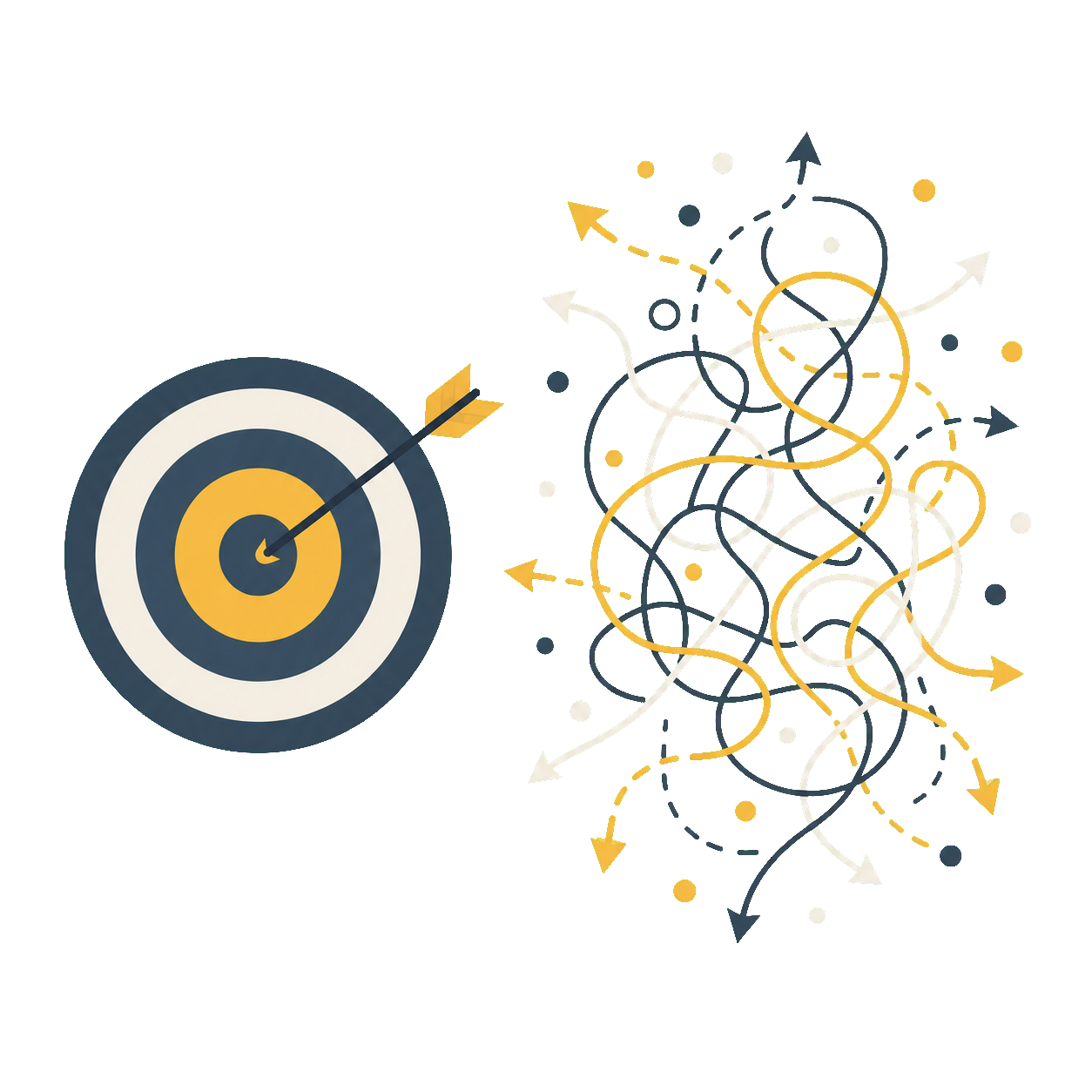
Early on it's tempting to collect indicators and strategies, on the idea that more tools mean better results. Most of the time the opposite happens: you spread yourself thin, never take anything all the way through, and can't say what worked and what didn't.
The difference between a beginner and an experienced trader isn't the number of methods, but a single method mastered well. You learn one, apply it until you understand it in depth, and only then add something else — if you still need to.
Starting points
A few simple approaches to start with
If you want a starting point, three approaches are accessible for a beginner and don't require technical terms to understand. Each has its own page, where we go into detail.
Trend following
You trade in the direction of the price's dominant movement: if the market is rising, you look to buy; if it's falling, the opposite. It's the most intuitive approach at the start, because you align with what the market is already doing instead of going against it.
See the pagecoming soonSupport and resistance
These are the price levels where the market has reacted in the past — zones where it tends to stop or reverse. You learn them because they underpin reading any chart, whatever method you choose later.
See the pagecoming soonBreakout
You enter when the price clearly breaks through an important level, on the idea that the move continues in that direction. It's easy to define and test on demo, which is why many beginners start here.
See the pagecoming soonThe list isn't exhaustive — these are the most accessible starting points, not the only methods that exist.
The decision
How to choose your first strategy
- 1
Start from the time you actually have
How many hours a day can you follow the market without it affecting the rest of your life? The answer already narrows your style: if you can't sit at the screen all day, you don't choose day trading.
- 2
You find it by trying, not by picking it on the first try
There's no method "that suits you" that you can guess in advance. You find it by testing a few approaches on demo and seeing which one you feel comfortable with.
- 3
Check whether you can stick to it consistently
A good method you don't follow is worth nothing. If an approach demands something you can't sustain — patience, speed, constant presence — it isn't for you right now.
- 4
Stick with one and go deeper
Switching from one strategy to another after every loss is one of the surest ways to drain an account. Pick one and give it time.
| Style | Time required | Position horizon |
|---|---|---|
| Day trading | High | Same day |
| Swing trading | Medium | Days–weeks |
| Position trading | Low | Weeks–months |
Scalping — a training ground on demodemo only
Scalping means very short positions, many of them in a single day. As a method for trading with real money at the start, it's not a good fit: it demands speed and takes a psychological toll. But it has one advantage on a demo account — you rack up many repetitions in a short time. Where a longer-term strategy gives you a few decisions a week, scalping on demo gives you dozens a day. Used that way, as an exercise on a demo account, it helps you read the market faster.
To avoid
Classic beginner mistakes
- Jumping straight to real money, skipping the demo account.
- Risking too much on a single position, so one failure hurts as much as ten wins.
- Switching strategy after every loss, without giving it time.
- Looking for ready-made signals instead of learning to decide on your own.
- Cluttering the chart with dozens of indicators that contradict each other.
- Not keeping a journal, so repeating the same mistakes without realizing it.
Frequently asked questions
Frequently asked questions
How much money should I start with?
There's no universal "correct" amount — it depends on your financial capacity and how much you're willing to risk without affecting your daily life. The recommendation that never changes: start on a demo account, with no real money, until the method becomes a reflex.
How long does it take to learn a strategy?
It depends on the time you put in and the method. We can't promise you a timeline — anyone who guarantees "X weeks to profit" is misleading you. What matters is repetition and the journal, not the calendar.
Can I use trading signals as a beginner?
You can, but it holds you back. If you follow someone else's signals without understanding why, you never learn to decide on your own and stay dependent. On this page we don't offer signals — we offer education.
Is scalping good for beginners?
As an exercise on a demo account, yes — it gives you many repetitions quickly and helps you read the market. As a method for trading with real money at the start, no — it demands speed and resistance to pressure that you build over time.
Trading or investing — which should I start with?
They're two different things, with different mindsets. If you're not sure where to start, read our guide from zero to trader and the page on how to start investing, then choose your direction.
Next step
Practice before you risk real money
Open a demo account and apply what you've read here, or discuss a starting plan with the Trading.md team.
Disclaimer. Trading and investing involve risks, including the risk of capital loss. The content on this page is for educational purposes and does not constitute investment advice, personalized financial advice, or a trading signal. Past performance does not guarantee future results. Trading.md is an intermediary between investors and regulated brokerage firms and is not a broker.