What is Forex?
Complete guide to the foreign exchange market — how it works, who participates, what risks are involved, and what you need to know before taking the first step. Financial education for Moldova.
What is Forex — Simple Definition
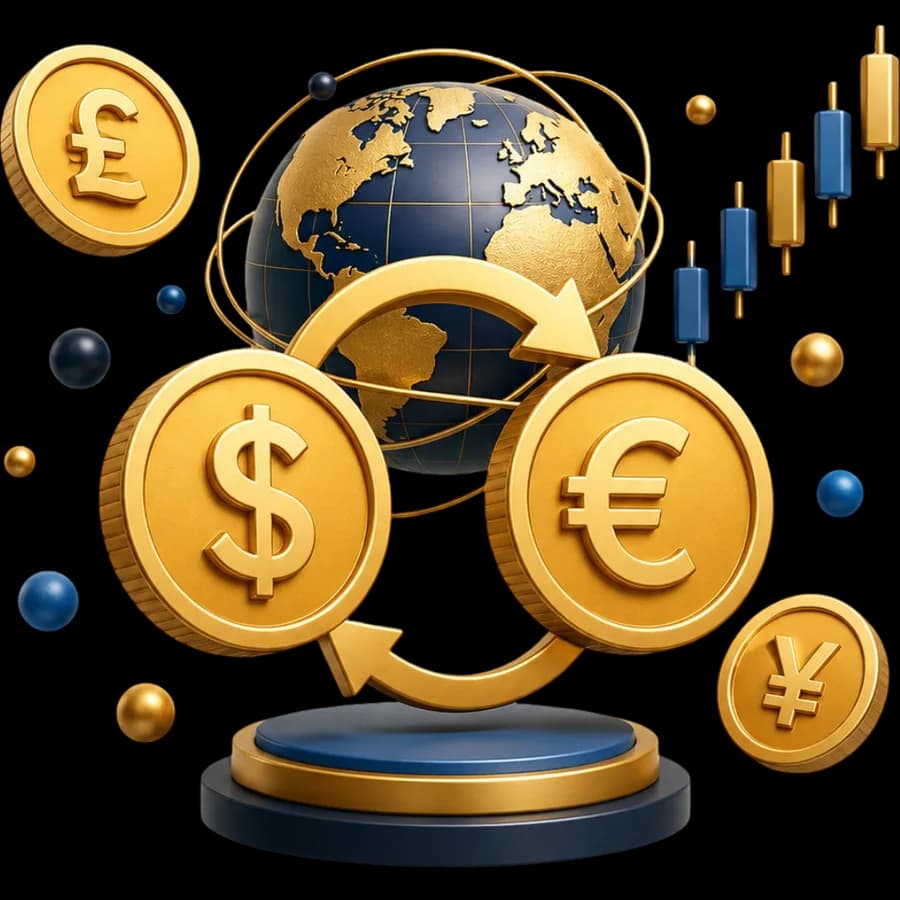
Forex (short for FOReign EXchange) is the global currency exchange market where the world's currencies are bought and sold. It is the largest financial market in the world, with a daily trading volume of approximately $9.6 trillion US dollars (source: Bank for International Settlements, Triennial Survey 2025).
Think of the nearest currency exchange office. When you exchange Moldovan lei (MDL) for euros before a trip, you're already participating in the currency market. Forex works on the same principle, only on a global scale, electronically and around the clock.
Unlike a stock exchange (which has a physical building), the Forex market has no central location. Transactions take place electronically, through networks of banks, financial institutions and trading platforms, 24 hours a day, 5 days a week.
Forex = FOReign EXchange = Currency exchange market. The world's largest financial market (~$9.6 trillion USD/day, per BIS 2025). Operates electronically, 24/5, with no central physical location.
History of the Forex Market
The Forex market as we know it today hasn't always existed. For centuries, exchange rates were fixed or government-controlled. Here are the key moments that shaped the modern currency market:
- 1944
Bretton Woods Agreement
44 countries established fixed exchange rates tied to the US dollar, which was backed by gold.
- 1971
The Nixon Shock
President Nixon suspended the dollar's convertibility into gold, collapsing the Bretton Woods system. Currencies began to float freely.
- 1973
Birth of Modern Forex
Countries officially adopted floating exchange rates. Currency prices became determined by supply and demand.
- 1979
European Monetary System
9 European states created the EMS with the Exchange Rate Mechanism, paving the way for the future euro.
- 1996
Forex Goes Online
First online brokers appeared, giving individual investors internet access to the currency market.
- 1999
Launch of the Euro
The Euro (EUR) was introduced as electronic currency across 11 European countries, quickly becoming the world's second most traded currency.
- 2010+
Digital Era & Regulation
Mobile and algorithmic trading. ESMA and national regulators introduce strict rules to protect non-professional investors.
How the Forex Market Works
On the Forex market, currencies are always traded in pairs. You can't buy euros without selling something in return — for example, US dollars. That's why we see notations like EUR/USD, GBP/JPY or USD/MDL.
Base and Quote Currency
The first currency in a pair is the base currency, the second is the quote currency (or counter currency). EUR/USD = 1.0850 means 1 euro is worth 1.0850 US dollars.
Bid, Ask and Spread
Bid is the price at which you can sell the base currency. Ask is the price at which you can buy it. The difference is called the spread — essentially the cost of the transaction.
For example, if EUR/USD has Bid = 1.0848 and Ask = 1.0850, the spread is 2 pips. The smaller the spread, the lower the trading cost.
What is a Pip?
A pip (Point in Percentage) is the smallest standard unit of price movement for a currency pair. For most pairs, a pip is the fourth decimal place — i.e. 0.0001. If EUR/USD moves from 1.0850 to 1.0851, it has gained 1 pip.
Important exception: for pairs that include the Japanese yen (JPY) — for example USD/JPY or EUR/JPY — a pip is the second decimal place (0.01), because the JPY has a much smaller nominal value than other major currencies.
Practical example: You buy EUR/USD at 1.0850 (Ask). If the price rises to 1.0900, you've gained 50 pips. If it falls to 1.0800, you've lost 50 pips.
Forex Market Participants
The Forex market isn't a place with just one type of player. From the world's largest central banks to individual home investors, each participant plays a different role:
Central Banks
Major influenceNBM, Federal Reserve, ECB — control monetary policy, interest rates, and intervene to stabilize exchange rates.
Commercial Banks (Dealer Banks)
~46% of volumeExecute the largest volumes of currency transactions.
Institutional Funds & Hedge Funds
~25% of volumeAsset managers, pension funds and hedge funds — manage billions and actively trade using sophisticated strategies.
Multinational Corporations
~6% of volumeExchange currencies for international trade.
Brokers & Dealers
IntermediariesIntermediaries providing market access to individual investors.
Non-Professional Traders (Retail)
~5-6% of volumeIndividuals trading through online brokers. Represent a small share of total volume.
How Currency Pairs Work
Currency pairs are classified into three main categories based on liquidity and economic significance.
Base vs Quote Currency
In any currency pair, the first currency listed is the base currency, and the second is the quote currency. The quote shows how many units of the quote currency are needed to buy one unit of the base.
For example, if USD/MDL = 17.80, it means 1 US dollar costs 17.80 Moldovan lei. The official daily rate is published on bnm.md.
Currency pairs with the Moldovan leu (MDL)
Although MDL is not actively traded on the international Forex market, the pairs USD/MDL and EUR/MDL are highly relevant to Moldova's economy. The official rate is set by the NBM based on interbank transactions.
Include the US dollar and currencies of the largest economies. Most liquid with tight spreads.
EUR/USD, GBP/USD, USD/JPY, USD/CHF, AUD/USD, NZD/USD, USD/CAD
Don't include the US dollar but combine other major currencies.
EUR/GBP, EUR/JPY, GBP/JPY, AUD/NZD, CHF/JPY
Include a currency from a developing economy. Wider spreads, lower liquidity.
USD/MDL, EUR/MDL, USD/RON, USD/TRY, EUR/PLN
Trading Sessions — Market Schedule
The Forex market operates 24 hours a day, 5 days a week. This is possible because as one session closes in a financial center, another opens elsewhere in the world.
There are four main trading sessions:
When is the market most active?
The largest volumes and highest volatility occur during session overlaps. The London–New York overlap (3:00–7:00 PM Chișinău time) is the most active period, accounting for more than 50% of daily volume.
Session times below are shown in Chișinău time (UTC+2 winter / UTC+3 summer).
Chișinău time (GMT+3)
01:00 — 10:00
03:00 — 12:00
10:00 — 19:00
15:00 — 00:00
What Influences Exchange Rates
Exchange rates reflect a country's economic health relative to another. A strong economy tends to have a strong currency.
Interest Rates
The most important factor. Rate hikes strengthen the currency; cuts weaken it.
Inflation
Low, stable inflation supports the currency. High inflation erodes it.
GDP
Economic growth attracts foreign investment and strengthens the currency.
Geopolitical Events
Wars, sanctions, and political instability sharply affect exchange rates.
Trade Balance
Export-heavy countries see greater demand for their currency.
Speculation & Market Sentiment
Trader expectations can move markets as powerfully as actual events.
Moldova (NBM)
The National Bank of Moldova (NBM) influences the leu (MDL) exchange rate through several tools: the base interest rate (refinancing rate), foreign-exchange operations (currency interventions to buy or sell), and reserve requirements for banks. When the NBM raises the interest rate, the leu tends to strengthen against the dollar and euro, because MDL deposits become more attractive. Diaspora remittances are also a significant factor — massive inflows of euros and dollars directly affect currency supply on the Moldovan market.
What is a Forex Broker
A Forex broker is a company that provides individuals access to the currency market through a trading platform (MetaTrader 4/5). Choosing a reliable broker is one of the most important decisions. Always verify the broker's license.
For a complete understanding of the instruments offered by brokers, see our guides What is a CFD and What is Trading.
Checklist: choosing a broker
- Verify regulation: the broker must be licensed by a recognized authority (FCA, CySEC, ASIC, BaFin)
- Check directly on the regulator's official website
- Check NCFM alerts at cnpf.md
- Test on a demo account first
- Avoid brokers promising guaranteed returns
Risks of Forex Trading
Forex trading involves significant risks. It's not a get-rich-quick method. According to ESMA data, 74% to 89% of non-professional investor accounts lose money when trading CFDs. Leverage amplifies both profits and losses.
Leverage
With 1:30 leverage, a move of just 3.3% against you can wipe out your entire invested capital.
74-89% lose money
ESMA data shows 74-89% of non-professional investors lose money trading CFDs.
Extreme volatility
Unexpected events can cause movements of hundreds of pips within minutes.
Legal Framework in the Republic of Moldova
In July 2025, Law No. 177/2025 entered into force, strengthening investor-protection measures for derivative financial instruments. With it, a clear legal framework emerged for Moldova's derivatives market.
What does the law provide?
The law completely bans the marketing, distribution and sale of binary options in the Republic of Moldova.
The law also imposes requirements on financial-service-provider firms regarding how they may promote leveraged derivative financial instruments (including Forex CFDs). Firms are not allowed to use training programs, courses, or social media as forms of promotion of these instruments to non-professional investors.
What does this mean for investors?
The law does not prohibit investors' access to authorized trading platforms. Individuals may independently access financial markets through internationally authorized brokers. The restrictions target service-provider firms, not individual investors.
Role of NCFM and NBM
The National Commission for Financial Markets (NCFM) supervises the capital market and publishes alerts about unauthorized entities. The National Bank of Moldova (NBM) regulates banking activity and currency operations. Always check on cnpf.md whether an entity is authorized before transferring money to it.
Forex Glossary
Understanding basic terminology is the first step for anyone wanting to study the Forex market:
Pip
The smallest unit of price movement for a currency pair. For most pairs, a pip is the fourth decimal place (0.0001). Exception: for pairs with the Japanese yen (JPY), a pip is the second decimal place (0.01).
EUR/USD: 1.0850 → 1.0851 = +1 pip; USD/JPY: 156.80 → 156.81 = +1 pip
Lot
Standard unit of transaction volume. 1 standard lot = 100,000 units of the base currency.
1 lot EUR/USD = 100,000 EUR; 0.1 lot (mini lot) = 10,000 EUR
Spread
The difference between the Bid (sell) and Ask (buy) price.
Bid 1.0848 / Ask 1.0850 = 2 pip spread
Margin
Collateral required to open and maintain a position.
With 1:30 leverage, margin for 1 lot ≈ 3,333 EUR
Leverage
A mechanism allowing you to control a position larger than your available capital. Amplifies both profits and losses.
1:30 = 1,000 EUR controls 30,000 EUR
Stop Loss
An automatic order that closes a position at a preset price to limit losses.
Buy at 1.0850, Stop Loss at 1.0820 = max loss 30 pips
Take Profit
An automatic order that closes a position at a preset price to secure profit.
Buy at 1.0850, Take Profit at 1.0900 = +50 pips
Volatility
The magnitude of price movements. High volatility = large, rapid moves up and down.
EUR/USD averages 50-80 pips per day; USD/TRY can move 200+ pips
Order
An instruction to the broker to buy or sell a currency pair. Can be a market order (executed instantly) or a limit order (executed at a specified price).
Buy Limit EUR/USD at 1.0800 = buy only if price drops to 1.0800
Margin Call
An automatic warning from the broker that the margin level in the account has dropped below the minimum threshold. It is not a position closure — it is a signal to deposit additional funds or close positions.
Broker issues a Margin Call when margin level drops below 100%
Stop Out (Margin Close-Out)
Automatic forced closure of positions by the broker when margin level drops below a critical threshold (per ESMA: 50% of required margin for non-professional investors). "Stop Out" is the trader-familiar term on MT4/MT5. "Margin Close-Out" is the ESMA regulatory term. They are the same mechanism.
At margin level below 50%, the broker automatically closes positions — this is Stop Out
Swap (Overnight)
The cost of holding a position overnight. Debited or credited automatically at rollover time (usually 00:00 server time). The amount depends on the interest rate differential between the two currencies in the pair.
If you hold a EUR/USD position overnight, the broker automatically applies the swap
Forex vs Stocks vs Crypto
Each market has its pros and cons. There's no 'best' market — only the one best suited to your risk profile.
| Criteria | Forex | Stocks | Crypto |
|---|---|---|---|
| Schedule | 24h/day, 5 days/week | Exchange hours | 24/7 |
| Daily Volume | ~$9.6 trillion (BIS 2025) | ~$200 billion | ~$50-150 billion |
| Max Leverage (EU) | 1:30 | 1:5 | 1:2 |
| Risk | Very high | Medium | Very high |
First Steps — How to Start Learning
The next step is to turn knowledge into practice — without risking real money.
Study the theory — read this guide and related articles
Understand the risks — re-read the risks chapter
Open a free demo account — practice without real money
Learn technical and fundamental analysis
Master risk management — Stop Loss, position sizing
Consider a structured course
Start with small amounts you can afford to lose
Frequently Asked Questions
What is Forex in short?
Forex (Foreign Exchange) is the global currency exchange market. The world's largest financial market (~$9.6 trillion/day, BIS Triennial Survey 2025). Operates 24/5, electronically, with no central location.
Can you make money from Forex?
Theoretically yes, but 74-89% of non-professional investor accounts lose money (ESMA). It's not a get-rich-quick scheme. Don't invest money you can't afford to lose.
Is Forex legal in Moldova?
Access to licensed platforms is not prohibited. Law 177/2025 bans binary options and restricts aggressive CFD marketing to non-professional clients.
How much capital do you need to start?
From $50-200 USD. Start with a demo account. Small capital + leverage = high risk.
What is leverage?
A mechanism to control a position larger than your capital. 1:30 leverage: 1,000 EUR controls 30,000 EUR. Amplifies both profits and losses equally.
What's the difference between Forex and the stock market?
Forex runs 24/5, stocks have fixed hours. Forex daily volume is ~$9.6 trillion (BIS 2025) — far larger than stock markets. Forex trades currency pairs, stocks trade company shares. Forex typically uses higher leverage (1:30 vs 1:5).
Is Forex gambling?
No, but it can become gambling without knowledge and strategy. The market is based on real economic factors that can be analyzed.
What is a pip?
The smallest standard unit of price movement. For most pairs, it's the fourth decimal place (0.0001). Exception: for pairs with the Japanese yen (JPY), a pip is the second decimal place (0.01).
How to choose a safe Forex broker?
Verify license (FCA, CySEC, ASIC). Check on the regulator's site and cnpf.md. Test on demo. Avoid guaranteed return promises.
What risks does Forex trading involve?
Leverage, volatility, counterparty risk, emotional decisions, fraud. 74-89% of non-professional investor accounts lose money on CFDs.
Why do most traders lose money?
Lack of education, poor risk management, excessive leverage, emotional trading, and no strategy.
What is a demo account?
A trading account with virtual money. Identical to real, but without financial risk. Perfect for learning.
What is technical analysis?
Studying charts, patterns, and indicators (MA, RSI, MACD) to predict price movements. Fundamental analysis evaluates economic factors.
What regulations exist in Moldova for Forex?
Law 177/2025: binary options banned; leveraged CFD marketing to non-professional investors restricted; training as marketing prohibited. NCFM supervises the market.
Are Forex profits taxed in Moldova?
Yes. Trading gains are considered capital gains under the Tax Code of the Republic of Moldova. The personal income tax rate is 12%, but the taxable base is only 50% of the realized gain (Art. 18(e) of the Tax Code). This makes the effective tax rate 6% of total profit. Filing is done via form CET18, deadline April 30 of the following year. We recommend consulting an accountant for your specific situation.
DISCLAIMER: This material is for informational and educational purposes only and does NOT constitute financial advice. According to ESMA, 74-89% of non-professional investor accounts lose money when trading CFDs. Consult a licensed financial advisor. Content complies with Law No. 177/2025 of the Republic of Moldova. Do not invest money you cannot afford to lose.