
National Commission for Financial Markets
The primary regulator of our industry. What CNPF does in the capital market, how it protects investors, and how to check whether a company has the right to provide financial services in the Republic of Moldova.
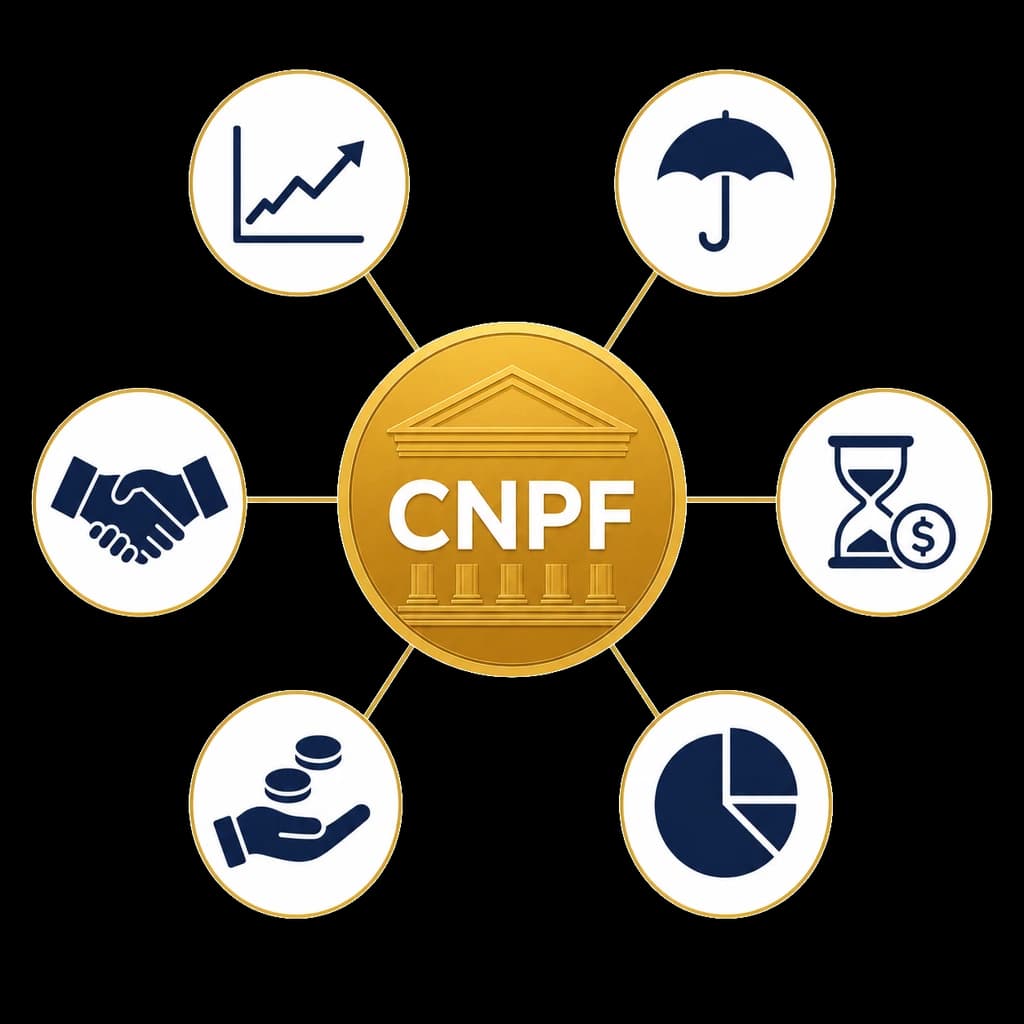
What is CNPF
The National Commission for Financial Markets (CNPF) is the autonomous public authority, accountable to Parliament, that regulates, authorizes, and supervises the non-bank financial market in the Republic of Moldova. It has organizational, functional, operational, and financial independence.
Its mission: the stability, transparency, and safety of the capital market, protecting the rights of financial-services consumers, and preventing market abuse. Its headquarters is in Chisinau, at 77 Stefan cel Mare si Sfant Boulevard.
CNPF does not supervise banks' prudential soundness — that's the job of the National Bank of Moldova. CNPF covers the rest: the capital market, insurance, private pensions, funds, and non-bank lending. You'll see the dividing line in Chapter 04.
The road to CNPF
Today's authority is the result of several institutions merging over time. The main milestones:
What it regulates and supervises
CNPF has three functions over the entities in its mandate: it regulates them (sets the rules), authorizes them (grants licenses), and supervises them (checks compliance with the rules).
| Area | What falls here |
|---|---|
| Capital market | Investment firms, the Moldova Stock Exchange, the Central Depository, securities issuers |
| Insurance | Insurers and intermediaries (RCA, Green Card, CASCO) |
| Voluntary pensions | Private pension funds — Pillar III |
| Investment funds | Collective investment undertakings (OPC) |
| Non-bank lending | Non-bank lending organizations, savings-and-loan associations |
The logic is the same across every area: without a CNPF license, a firm cannot provide these services, and after authorization it stays under continuous supervision.
The area we care about most — investing and trading — falls under the capital market. We cover it in detail in Chapter 05.
CNPF vs BNM — who does what
These are two different authorities, and many people confuse them. The simple rule: CNPF covers the non-bank financial market, while BNM covers banks, monetary policy, and the exchange rate. Confusion arises with products at the boundary between them — so it's clearer case by case:
| What you have or do | Who's responsible |
|---|---|
| Bank account or deposit | BNM |
| Loan from a bank | BNM (prudential) + CNPF (customer conduct, since 2024) |
| Loan from a non-bank organization | CNPF |
| Insurance policy (RCA, CASCO) | CNPF |
| Account at an investment firm, stocks, bonds | CNPF |
| Government securities (eVMS) | Ministry of Finance (issuer) + BNM (platform) |
| Currency exchange | BNM (licensing) + CNPF (conduct, since 2024) |
Since 2023–2024, on the conduct and consumer-protection side, CNPF has also been given powers over certain banking segments (loans, payments, currency exchange). Banks' prudential supervision, however, remains with BNM. Details on the dedicated pages: BNM, eVMS, and the exchange rate.
CNPF, the capital market, and investing in Moldova
In the capital market, CNPF authorizes investment firms (those that can buy and sell securities on clients' behalf), supervises the Moldova Stock Exchange, the single Central Depository, and securities issuers.
What this means for an investor: to buy shares or bonds of Moldovan companies, you do it through an investment firm licensed by CNPF. The local market has low liquidity and few listed companies — we compare the real options on the Invest in Moldova page.
Government securities are issued by the Ministry of Finance and accessible through the eVMS platform. For the tax side of investing, see the Taxation page.
An investor from the Republic of Moldova can invest and trade freely — both on the local market and on international markets. Locally: shares of Moldovan companies are hard to access (low liquidity, only through licensed investment firms), whereas government securities via eVMS are simple for anyone to buy. Internationally: access is free, through brokerage firms regulated abroad. The legal framework imposes no restrictions on individuals. What's allowed and how to check legality — on the Legal trading in Moldova page.
How it protects investors
CNPF protects non-professional participants through several mechanisms:
Public registries
CNPF publishes the list of entities licensed and authorized in the capital market. Anyone can check whether a company has the right to provide investment services.
The warning list
The "CNPF warns" section flags unauthorized companies that promote investments with promises of large, fast gains. It's the first place to check before putting money into an unfamiliar platform.
The Investor Compensation Fund
A mechanism set out by Law No. 171/2012 on the capital market, which compensates investors if a member investment firm becomes insolvent and cannot meet its obligations, within the limits set by law.
Complaints, breaches, and scams — who does what
If you have a problem with an entity supervised by CNPF (insurer, non-bank lender, investment firm), you can file a complaint. The steps:
- Complaint to the provider. First you contact the company; it has a legally set deadline to respond.
- Complaint to CNPF. If you're not satisfied, you file a signed complaint (electronic or handwritten), at the CNPF office or by email with an electronic signature. Anonymous complaints are not examined.
- Review. The review period is generally 30 days, extendable by no more than 15 days. CNPF can establish breaches, order corrective measures, and apply sanctions.
CNPF supervises authorized entities. If you're the victim of fraud or an unauthorized platform, CNPF can add it to the warning list, but recovering the money and criminal prosecution are matters for the police and the prosecutor's office. CNPF is not a criminal-investigation body.
See Moldova's entire financial system
How CNPF, BNM, the stock exchange, and real investing in Moldova connect — and where financial education starts.
How to check whether an entity is authorized
Three steps, with the official sources:
| Step | Where to check |
|---|---|
| 1. Search for the entity in the CNPF registry | The list of licensed/authorized persons in the capital market (cnpf.md) |
| 2. Check the warning list | The "CNPF warns" section (cnpf.md) |
| 3. For international brokers | The registries of the broker's regulator (ESMA, FCA, CySEC, etc.) |
Moldova has no local brokers of the international type. Access to global markets happens through brokerage firms regulated abroad. How to choose one — in the dedicated guide.
What firms can do once authorized by CNPF
A firm cannot provide investment services in the Republic of Moldova without a CNPF license. The regulator grants several types of permits, depending on the activity:
| Type of firm | What it can do |
|---|---|
| Investment firm | Provides investment services and activities (Category A, B, or C license — the category determines which services are permitted) |
| Management company | Manages funds and collective investment undertakings (OPC) |
| Market operator | Organizes the regulated market and the multilateral trading system — a role held by the Moldova Stock Exchange |
| Central depository | Records and settles securities |
| Registry company | Keeps issuers' shareholder registries |
| Investment consultant | Investment advice, once authorized |
Investment services an investment firm can provide
Receiving and transmitting orders; executing orders on clients' behalf; trading on own account; portfolio management; investment advice; underwriting and placement of financial instruments; intermediating public offerings.
At present, a firm licensed by CNPF operates within the territory of the Republic of Moldova. Law No. 171/2012 already transposes European directives. Once the MiFID II directive is fully transposed and Moldova joins the EU, a licensed firm could provide services cross-border within the European area (European passport). The framework is being prepared.
Harmonization with the European Union
CNPF is gradually aligning Moldova's framework with European rules, as part of the national EU accession program (2025–2029). Its development partners include the International Monetary Fund, the World Bank, the European Commission, and BERD.
What this means for investing
The capital market is regulated by Law No. 171/2012, which aligns the framework with European standards (the reference being the MiFID directive). ESMA is Europe's authority for financial markets; brokers regulated in the EU operate under ESMA and national authorities.
Crypto — what's next
At the European level, MiCA is the framework for crypto-asset markets. In Moldova, cryptocurrencies are not yet regulated; a future framework is taking shape, with the European model as the reference.
Terms like CNPF, ESMA, or MiFID — briefly explained in the Glossary.
Professional certification and career
For anyone who wants a career in Moldova's financial sector, CNPF issues qualification certificates to specialists working at professional participants (investment firms, insurers, funds, savings-and-loan associations).
What the certificate is
- A document confirming the right to work as a specialist in the non-bank financial market
- Required for certain roles at authorized firms
How to get it
- An education diploma (university/postgraduate, for the capital market)
- An examination before the CNPF board
The areas covered include the capital market (securities), insurance (including actuarial work), and savings-and-loan associations. For some segments, certification also involves the National Bank, following the transfer of responsibilities in recent years.
CNPF certification is for professionals employed at authorized firms. If you just want to understand investing and trading for yourself, start with our financial education section.
CNPF and financial education
CNPF plays a public-information role: financial-education campaigns, materials on loans, insurance, and fraud prevention, plus a consumer phone-advice line. The official cnpf.md website is a direct source for anyone who wants to check an entity or do their research.
For the basics of investing and trading, explained step by step, continue with our financial education section.
Frequently asked questions
Yes. The legal framework imposes no restrictions on individuals from Moldova. They can invest and trade on international markets through brokerage firms regulated abroad. Details on the Legal trading in Moldova page.
You first contact the company. If you're still not satisfied, you file a signed complaint with CNPF (at its office or by email with an electronic signature). The review period is generally 30 days.
If the entity is supervised by CNPF, you can file a complaint. For criminal fraud or unauthorized platforms, recovering the money and prosecution fall to the police and the prosecutor's office; CNPF can issue public warnings.
BNM handles banks, monetary policy, and the exchange rate. CNPF handles the capital market, insurance, private pensions, funds, and non-bank lending.
In the CNPF registry and the warning list on cnpf.md. For international brokers, also check the registry of the authority that regulates them (ESMA, FCA, CySEC, etc.).
Note. This page is for informational and educational purposes and describes CNPF's role as a regulator. It does not constitute investment, legal, or tax advice. Information about CNPF is sourced from official sources (cnpf.md, legis.md) and can be verified directly at the source. Investing in financial markets involves risk, including the risk of capital loss.