
Moldova Stock Exchange
Moldova's first stock exchange, open for trading since 1995 and supervised by CNPF. Here we explain what it is, where it comes from, how the regulated market and the multilateral system work, what is traded and how to access it — including what to do with old paper shares from the privatization years.
- What it is
- History
- Old shares
- Regulated, MTF, OTF
- How to access it
- FAQ

What the Moldova Stock Exchange is
The Moldova Stock Exchange (BVM) is the operator of the regulated securities market in the Republic of Moldova. In short, it is the organized venue where demand and supply meet for financial instruments such as shares, corporate bonds, and government securities, under clear rules for admission and trading.
BVM operates under the authorization and supervision of the National Commission for Financial Markets (CNPF). It runs two trading venues — a regulated market and a multilateral trading facility (MTF) — which we detail below. Official information, statistics, and current listings are published on its own website, bvm.md.
Brief history
BVM was founded in December 1994, and the first trades took place on 26 June 1995 — the day considered the exchange’s “birthday.” Its founding involved 34 founders, professional participants in the securities market.
In its early years, the exchange was closely tied to the mass privatization process. Through this process, some 1.400 enterprises were converted into joint-stock companies and privatized. At the time the exchange launched, there were, alongside these, dozens of investment funds and trust companies, and the number of shareholders exceeded three million.
With Law no. 171/2012 on the capital market, admission rules tightened, and the number of companies listed on the exchange fell significantly. This legacy raises a question many people still have today — about the certificates they received back then.
Do you have an old paper share or bond?
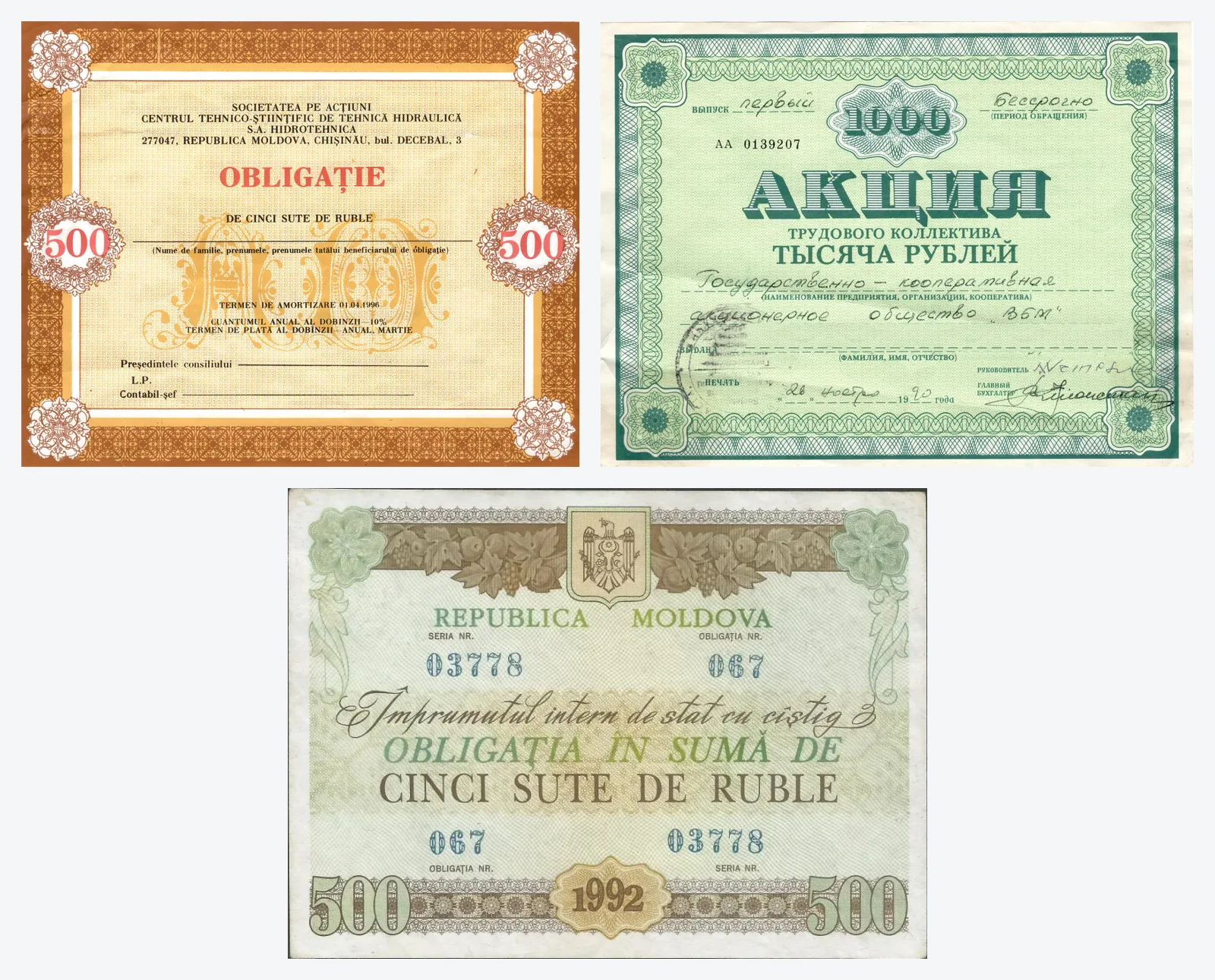
Many Moldovans keep paper certificates at home received in the ’90s: shares in joint-stock companies or bonds. The natural question is: are they still worth anything, and what can you do with them?
How people came to have them
In the early ’90s, the state distributed patrimonial vouchers to every citizen — a kind of privatization “ticket”, whose size was calculated based on length of employment. With these vouchers you could buy shares directly at auctions or, most often, hand them over to an investment fund or a trust company, which pooled the vouchers of many people and bought share packages on their behalf.
What guarantees existed, and why many ended up with nothing
Patrimonial vouchers gave the right to participate in privatization — not a guarantee of gain or of value. The value depended on the company or fund the money ended up in. Many investment funds consolidated, were liquidated, or reorganized into joint-stock companies, and some enterprises went bankrupt. That is how some people ended up with shares that were worthless or hard to sell. This is a pattern common to all voucher privatizations across the former Soviet states, not a Moldovan particularity.
The state provided the legal framework and a regulator (CNPF), plus a system that still keeps records of share ownership today. What did not exist — and could not have existed — was a guarantee of value: that depends on company performance, not the state.
What the situation is now and how to check
The good news: the record of who owns which shares is preserved. It is kept either by the Central Securities Depository (DCU) or by a registry company. CNPF publishes the list of which entity keeps the registry for each company, so the first step is to find out where your company is registered. Then request an account statement — the document confirming whether you still hold the shares, and how many. For inherited certificates, ownership is clarified through a notary.
If the company still exists, you may be entitled to dividends or may be able to sell the shares through an investment firm. If the company has been dissolved, the shares probably no longer have value. Important to know: there is no mechanism that compensates for historical privatization losses — the investor compensation fund (up to the equivalent of 1.000 EUR) covers the bankruptcy of a licensed investment firm, not companies that closed down over time.
In 2025, CNPF publicly urged shareholders to check and update their details in the Shareholders' Register. Notifications sent to an old address are considered valid even if they never reach you — which is why checking matters. Every case is different; the information here is for informational purposes and is not legal advice.
The regulated market, the MTF, and what's next (OTF)
Beyond the legacy of the past, here is how the exchange is organized today. The same institution runs two trading venues — the term used in European legislation for the organized venue where trades are concluded — each with different rules, and the difference matters directly to you as an investor.
The regulated market
This is the trading venue with the strictest requirements. For share admission, the law generally requires predictable capitalization or own capital of at least the equivalent of one million euros, and a free-float of at least 10%. Issuers have extensive transparency and reporting obligations. This is where, for example, corporate bond issues from banks and government securities are admitted.
The multilateral trading facility (MTF)
The MTF is a trading venue with more relaxed admission requirements, designed for companies that do not meet the regulated market's thresholds. This is where you find shares of a number of joint-stock companies, some admitted provisionally. It is also supervised by CNPF, but offers issuers simpler access.
| Regulated market | MTF | |
|---|---|---|
| Admission requirements | Strict (capital, free-float, transparency) | Relaxed |
| For whom | Large issuers, banks, the state | Smaller companies |
| What you find | Corporate bonds, government securities | Shares of some joint-stock companies |
| Supervision | CNPF — for both | |
What this means for you
Generally, you don't choose the trading venue yourself — you buy an instrument, and it is already listed on one of them. Still, the difference tells you two useful things before you buy: how many transparency obligations the issuer has and, as a rule, how easily you'll be able to sell it later. A share on the regulated market comes with a more transparent issuer and stricter rules; one on the MTF, with more relaxed requirements. Before you buy, check where the instrument is listed — on the regulated market or the MTF. It's a signal about what you're buying and what risk you're taking on.
A draft law on financial instrument markets, aligned with European standards (MiFID II/MiFIR), has been in public consultation since March 2026. Among the new features: a third type of trading venue — the organized trading facility (OTF, Organised Trading Facility). Unlike the regulated market and the MTF, the OTF is intended for instruments that are not shares (for example bonds or derivatives) and gives the operator some discretion in executing orders.
Worth noting: the OTF does not appear automatically at BVM or at any other existing operator. It is a new avenue, open for authorization at CNPF — an interested firm can create and run one if it chooses to invest in it. Its role: to bring under regulation and transparency transactions that today often take place bilaterally, outside the exchange (over-the-counter, OTC).
What is traded today
The exchange's current activity is concentrated on a few types of instruments. The most visible are corporate bonds — for example, issues from commercial banks — and government securities admitted to trading, alongside a small number of shares on the MTF.
The local market is small compared with economies in the region: capitalization relative to GDP is around 10–30% in Eastern Europe and over 65% in the European Union. Exact figures on issuers and capitalization change over time; for up-to-date data see the local charts and CNPF reports.
The legal framework and the capital requirement
BVM is authorized by CNPF as a market operator and regulated market. Law no. 171/2012 on the capital market sets the operating rules, including a minimum own-capital requirement of the equivalent of one million euros for the market operator (art. 61).
Since 2021, BVM has faced difficulties meeting this requirement. The compliance deadline was extended by Law no. 177/2025 to 14 September 2026.
The capital requirement applies to the market operator — the company that runs the exchange — and is meant to ensure orderly operation and cover risks. It does not limit people's right to invest. Details on what is legally permitted in Moldova can be found on the page Legal trading in Moldova.
How you access BVM as an individual
Individuals do not trade directly on the exchange. Access is through an intermediary — an investment firm licensed by CNPF — which receives and transmits orders. The full list of intermediaries is published in the register of licensed entities on the CNPF website (the official source, not forums).
One thing to expect: at the local exchange, access through an intermediary is order-oriented, not built around a modern app with real-time charts. That experience — a platform, a mobile app, live charts — is offered by regulated international brokers and, in the future, the new Moldova International Exchange.
How to choose an intermediary, how to open an account, and how to place your first order — the full mechanics, valid for all local investment options, are on the page Invest in Moldova. For government securities there is also a direct online channel, with its own mechanics, on eVMS.
BVM and the Moldova International Exchange
It is easy to confuse the two. The Moldova Stock Exchange is the existing exchange, dating from 1995. The Moldova International Exchange (BIMx) is a new project, currently in the authorization process at CNPF, built in partnership with the Bucharest Stock Exchange.
| Moldova Stock Exchange | Moldova International Exchange | |
|---|---|---|
| Status | Operational since 1995 | In authorization at CNPF; launch estimated Sept. 2026 |
| Platform | Proprietary system | ARENA Trading (BVB technology) |
| Ownership | Private, historical | Public-private partnership (APP, BVB, banks, insurers) |
| Initial objective | Existing market | First issuers and attracting brokers |
Details on the new exchange, the timeline, and what it means for companies and investors are on the dedicated page: Moldova International Exchange.
What this means for you
For an investor in Moldova, the local exchange today offers a limited number of instruments. That does not mean the local market is pointless: government securities, for example, remain an accessible, low-risk instrument, and the admission of corporate bonds shows a market that is moving.
For diversification and access to more liquid instruments, many investors also turn to regulated international markets. The choice depends on goals, time horizon, and risk tolerance — which is why education and a conversation with a specialist help before any decision.
Compare the real options available locally on the page Invest in Moldova, or see how to access global markets through regulated brokers.
Frequently asked questions
Check who keeps the company's registry — the Central Securities Depository (DCU) or a registry company — and request an account statement. That's how you find out whether you still hold the shares and whether they still have value. For inherited certificates, ownership is clarified through a notary.
Disclaimer
The information on this page is for educational and informational purposes and does not constitute investment, tax, or legal advice. Investing in securities involves risks, including the liquidity risk specific to the local market. Figures on issuers and market capitalization may change over time; for up-to-date data consult official sources (CNPF, BVM, DCU).
Want to understand your real investment options?
Talk to a specialist about the local market and international ones, or start with the basics in a structured course.