
What Is Trading?
A complete guide to trading on the financial markets — from definition, history, and styles, to famous traders, real risks, and the right steps for a beginner from the Republic of Moldova.
What is trading
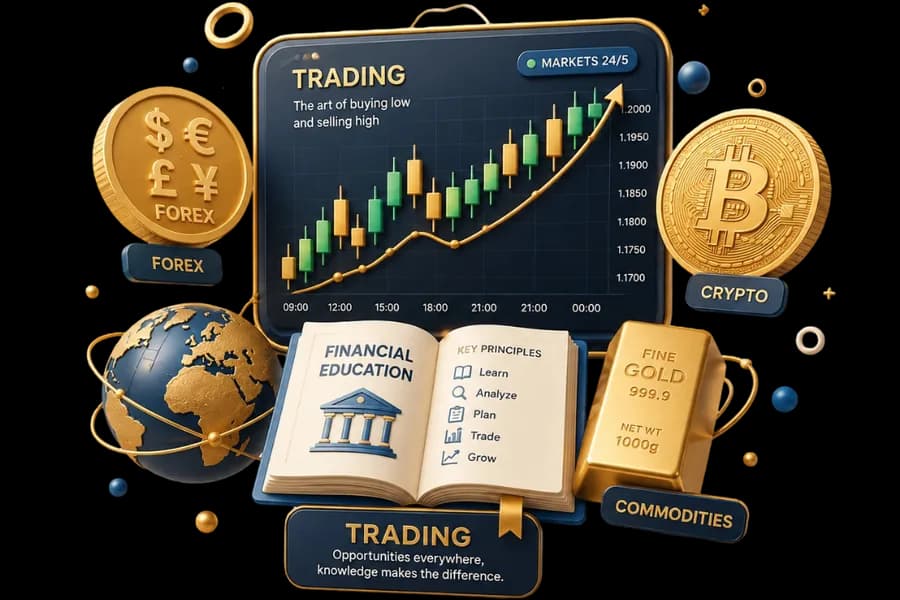
Trading (or transacting, the official term in the Romanian language) means buying and selling financial instruments with the goal of making a profit from the difference in price. This includes stocks, currencies, commodities, stock indices, cryptocurrencies — any asset that can be traded on an organized market.
The fundamental mechanism is simple: the trader forms a hypothesis about the direction of the price, opens a position, and the market either confirms the forecast (making a profit) or moves in the opposite direction (recording a loss). What makes the difference between disciplined trading and pure chance is the method: technical analysis, fundamental analysis, risk management, and a clear plan of action.
Speculation is not a negative word in this context — it is the mechanism that provides liquidity to modern markets. Without speculators, prices would move rarely and chaotically. With them, markets find the balance between supply and demand in real time.
Trading takes place on organized exchanges around the world — NYSE and NASDAQ in the USA, LSE in the United Kingdom, the Tokyo Stock Exchange in Japan, Deutsche Börse in Germany — and on global over-the-counter markets (the Forex currency market, OTC commodities). In the Republic of Moldova, there are currently no brokerage companies that offer access to trading and investing on foreign exchanges. That is why MD citizens access the global markets through local intermediary firms, partners of regulated international brokers.
The word "transacting" comes from the Latin transactio — "passage," "exchange." The term "trading" entered the Romanian financial vocabulary en masse only after 1990, with the opening of the post-communist markets and Romania's accession to the global economy.
Trading vs Investing — key differences
On the financial markets there are two main occupations, both carried out on the same charts, but with completely different mindsets, strategies, and time horizons. The difference is not technical — it is philosophical.
The trader is the one passionate about charts, technical analysis, and the market's daily movements. For them, trading is a profession or an active occupation — they spend hours in front of screens, look for short-term opportunities, and open and close positions frequently. They build their income through quick reaction and discipline.
The investor looks for passive income. They put their capital to work for them over the long term — they buy solid assets, hold them for years or decades, and benefit from dividends and the appreciation of value over time. They don't open the app every day.
Three technical differences matter more than the philosophy:
- Profit from both directions. In trading you can earn money both when the price goes up (long) and when it goes down (short). In classic investing, only from a rise and dividends.
- No real ownership. In trading via CFD you don't own the Apple stock — you speculate on the price difference. In investing you actually buy the stock and become a co-owner.
- Leverage available. In trading you can open positions several times the size of your capital, through capital borrowed from the broker. In long-term investing it is rarely used.
| Criterion | Trading | Investing |
|---|---|---|
| Time horizon | Seconds → months | Years → decades |
| Transaction frequency | Daily / weekly | Monthly / annual |
| Source of profit | Price movement (up and down) | Dividends + value appreciation |
| Asset ownership | No (via CFD) | Yes |
| Leverage | Yes (frequent) | No |
| Active time required | High | Low |
| Emotional stress | High | Medium |
| Type of income | Active | Passive |
| Suitable profile | Passionate about analysis and action | Patient, long-term oriented |
The two approaches don't exclude each other — many people do both, separately. An investor can have a long-term portfolio in stocks and ETFs, and in parallel a smaller account for active trading. What matters is not mixing the capital and strategies of the two.
A brief history of trading
From physical exchanges with shouting to algorithms that execute transactions in microseconds — the history of trading tells the story of the democratization of the financial markets. Here are the essential milestones that explain where today's financial world came from.
- 1602
The Amsterdam Exchange
The first modern stock exchange in the world. The Dutch East India Company (VOC) issues the first public shares — to finance trade expeditions to Asia.
- 1792
The Buttonwood Agreement — founding of the NYSE
24 brokers sign an agreement under a buttonwood tree at 68 Wall Street, New York. The two-sentence document marks the founding of the New York Stock Exchange.
- 1867
The emergence of the stock ticker
A dedicated telegraph for stock market information. For the first time, prices can be transmitted quickly to investors outside the trading floor.
- 1971
The end of Bretton Woods + the launch of NASDAQ
The dollar comes off the gold standard, exchange rates become floating — the modern Forex currency market is born. NASDAQ becomes the first fully electronic exchange.
- The '90s
Online trading
Internet platforms allow, for the first time, anyone with a PC and a connection to open their own account, without calling a broker on the phone.
- The 2000s
The algorithmic era & the first MD representative offices
Algorithms execute millions of orders per second. The first representative offices in the Republic of Moldova of offshore brokers (not regulated to European standards) appear.
- The 2010s+
The mobile era & democratization
Smartphone apps, drastically reduced commissions, copy-trading, AI. The individual trader becomes a relevant force in the market.
- 2018
Trading.md — the first MD project with regulated brokers
The launch of trading.md by Royal Consulting — the first project from Moldova with several international partner brokers, all regulated, including investment banks.
Who is a trader
A trader is a person who actively buys and sells financial instruments with the goal of profiting from price movements. But the term "trader" covers very different realities — from the individual with a laptop, to the professionals at investment funds who manage billions of dollars.
Types of traders by the context in which they work
Individual trader
Trades their own capital through a broker. The most widespread form globally and fully accessible from Moldova through the intermediary firms partnered with regulated international brokers.
Hedge fund trader
Works at funds like Citadel, Bridgewater, Renaissance Technologies. Fund capital (billions), advanced studies in mathematics, statistics, or quantitative finance.
Bank desk trader
Goldman Sachs, JPMorgan, Deutsche Bank, UBS, and other global banks have trading desks with dozens of specialized traders. They work with the bank's capital and do market making.
Trader at a prop trading firm
Modern firms that give you access to their capital after you pass a rigorous evaluation. They represent a democratization of access to institutional trading.
Trading.md, as a partner firm of regulated international brokers, provides — through consulting and support — access to trading on the global exchanges through our partners, verified over many years. We are not an employer of traders — for an institutional trader career in Moldova there are almost no local positions. The realistic options are: individual trading as your own activity, a modern prop trading firm, or moving to London, Frankfurt, Zürich, or Bucharest.
Formal education for an institutional career
For those who want a professional career as an institutional trader, the classic path goes through university studies in mathematics, statistics, econometrics, finance, computer science, or economics. These studies are complemented by internationally recognized certifications: CFA (Chartered Financial Analyst — a three-level program considered the industry's gold standard), FRM (Financial Risk Manager), or CMT (Chartered Market Technician).
In the European Union, the respected certifying institutions are CISI (Chartered Institute for Securities & Investment, UK), EFFAS (European Federation of Financial Analysts Societies, with the CEFA program — Certified European Financial Analyst), EFPA (European Financial Planning Association), and CIIA (Certified International Investment Analyst). These are serious paths, which require years of study and considerable financial investment.
For those who want a top career in the institutional financial industry, these certifications are welcome — even necessary. But most active traders in the world are not institutional, but individual traders — mostly self-taught, who learn from classic books, specialized courses, mentorship, and practical experience on a demo account, then on a real account with suitable capital. This is also the realistic path for an individual trader from Moldova. Details about schools, certifications, and programs can be found in the Financial education section of the site.
What can be traded
The financial markets offer access to many different asset classes, each with its own specifics. Before going through the list, an important clarification for beginners: asset classes (what you trade) and trading instruments (how you trade) are two different things.
Trading instruments
In practice, in Europe and Moldova, speculative trading on most asset classes is done through CFDs (Contracts for Difference) — a derivative instrument that lets you profit from the price movement without owning the physical asset. Read the complete CFD guide →
Futures (forward contracts) are popular in the US for indices and commodities, but less so at an individual level in the EU. Options (call/put) are highly developed as a trading instrument in the US, weaker at retail level in Europe. ETFs are composite instruments that track an index, a sector, or an industry — they can be traded like regular stocks. Classic investing is usually done through direct purchase (real ownership of the assets).
Asset classes accessible for trading
Stocks
Shares in companies listed on exchanges — Apple, Tesla, Microsoft, but also European or Asian companies. Profit from price growth and from dividends.
The currency market (Forex)
Global currency pairs — EUR/USD, GBP/USD, USD/JPY, and dozens of others. The largest market in the world by volume, open 24/5.
→ Read the complete guideStock indices
S&P 500, DAX 40, FTSE 100, Nikkei 225. An index measures the performance of a basket of stocks representative of a market or sector.
Commodities
Gold, silver, oil, natural gas, copper, agricultural commodities. Markets with their own volatility, influenced by macro and geopolitical events.
Cryptocurrencies
Bitcoin, Ethereum, and others. In Moldova, the crypto market is set to be regulated starting in 2026, according to the CNPF.
ETFs
Diversified pooled funds that track an index (S&P 500), a sector (technology), or a theme (green energy). Traded like ordinary stocks.
Bonds
Debt instruments issued by states or corporations. More suitable for long-term investing (holding until maturity for interest) than for active speculative trading.
Important: the same assets can be used both in investing and in trading — the AAPL chart is the same on the investor's screen and on the trader's. The difference is made by the type of account and the instrument chosen. With an investing account you buy the Apple stock and become a co-owner. With a trading account you usually use a CFD on Apple — you speculate on the price difference, without ownership, with the possibility of shorting and leverage.
How a trade works
Every trade starts with a hypothesis: the price will go up or down. The trader opens a long position (buying) if they're betting on the price rising, or a short position (short selling) if they're betting on it falling. The short position is the concept that surprises many beginners — yes, you can make a profit even when the market falls.
Profit or loss = the difference between the entry price and the exit price, multiplied by the position size. With the effect of leverage, both the profit and the loss are amplified. Leverage is a double-edged sword — it lets you trade amounts larger than your capital, but it can ruin you quickly if the market moves against you.
To close a position, the trader presses the close order button, and the platform executes, behind the scenes, the reverse operation of the opening (it sells if they bought, or buys if they sold short).
Two essential orders for risk management are mandatory for any serious trader: stop-loss (automatically closes the position at a predefined loss) and take-profit (automatically closes the position at a predefined profit target). Most catastrophic losses in the history of individual trading share a common cause: the absence of a stop-loss, or removing it in a moment of panic, "let me give the market one more chance." Discipline with these orders separates the professional trader from the amateur.
These details and many others — correctly calculating the position size, the risk/reward ratio, pending orders — are taught in depth in our courses.
Profit / loss calculator
Enter data and instantly see how much you would gain or lose on a trade. Change the prices to test different scenarios.
Trading styles
Not all traders do the same thing. The trading style is chosen based on available time, temperament, and objectives. The four main styles cover the entire spectrum.
| Style | Position duration | Trades | Suitable profile |
|---|---|---|---|
| Scalping | Seconds-minutes | 10-100+/day | Fast reflexes, full-time in front of screens |
| Day trading | Hours (intra-day) | 1-10/day | Available during the active session |
| Swing trading | Days-weeks | 1-5/week | Daily job, checks positions in the evening |
| Position trading | Weeks-months | 1-2/month | Patience, focus on fundamental analysis |
Important to understand from the start: the styles are very different in pace, effort, and profile. Scalping and day trading require continuous attention, fast reflexes, and decisions under pressure — they're for those who want to be constantly active in the market and have the time to sit in front of screens. Swing and position trading require patience between setups and the ability to hold positions for days or weeks — they're for those who want to manage trading in parallel with a job or other activities. No style is "better" — there's a style suited to your pace of life and your risk profile. Test them on a demo account before making a conscious choice.
The EET time zone (UTC+2 in winter, UTC+3 in summer) catches the London session between approximately 10:00-19:00 local time and the New York session between 15:00-24:00. This means that people who work a 9-to-6 schedule can comfortably do swing trading or position trading, checking their positions in the evening without interfering with their main job — a real geographic advantage compared to other traders around the world. In particular, the London + US overlap (approximately 15:00-19:00 MD time) is the most attractive time of day, with the highest volume and interesting fluctuations for scalpers and day traders. For comparison: a trader from Australia or Asia, in order to benefit from these movements, has to work at night.
A trader's equipment
The myth "you need 6 monitors to be a trader" — not everyone needs that. The equipment depends strictly on the style chosen and the frequency of trades. Here is the natural evolution of setups — from minimal to professional.
For an individual trader from Moldova, the absolute minimal cost can be a phone or tablet — but it's not the best idea. On a phone you can, at most, monitor an order that's already open when you're not at your desk. Technical analysis, trade planning, and the basic work in trading are done in good technical conditions — one or a few large monitors, so you have a broad view of the charts live. The trading platform, real-time market data, technical analysis tools, alerts — all are included for free through the chosen broker.
A practical advantage: your trading account works simultaneously on PC and on phone. You can open a position from your computer when you're at your desk with the analysis laid out on large screens, then monitor it from your phone on the way home. You use the device suited to the moment, without losing access to your account.
The difference in "screen width" and computing power becomes relevant only for intensive styles like scalping or active day trading, where you need to simultaneously follow multiple charts, price levels, and news flow.
Famous traders — stories and lessons
Trading has created legends and buried fortunes. Here are a few names worth knowing — both for their remarkable successes and for the catastrophic losses that left lasting lessons. The balance between the two perspectives matters: success without context easily becomes myth, and myth makes you underestimate risk.
The stories below demonstrate one fundamental thing: in trading, risk management matters more than pure genius. Large profit without protection = an even larger loss. The best traders in history have also made huge mistakes — the difference is made by the risk structures that let you survive to play another day. Read the complete biographies on the blog →
The great winners
George Soros
"The man who broke the Bank of England" (1992). He bet massively on the decline of the pound sterling, forcing the United Kingdom to exit the European exchange rate mechanism. Estimated profit: 1 billion dollars in a single week.
Jim Simons
A mathematician who founded Renaissance Technologies. The Medallion Fund — an average annual return of about 66% gross (39% net after fees) between 1988 and 2018. The best-performing fund in history, closed to the public.
Paul Tudor Jones
He predicted the Black Monday crash of 1987 and tripled his profit that week. Tudor Investment Corporation — one of the first major hedge funds in the world, still active today.
Stanley Druckenmiller
Mentored by Soros, he co-architected the famous short on the pound sterling. Duquesne Capital — zero losing years in 30 years of activity, before his voluntary retirement.
Lessons from catastrophic losses
Jesse Livermore
Considered one of the greatest speculators of the 20th century. He made and lost immense fortunes several times, reaching 100 million dollars in 1929. His psychological discipline gradually abandoned him. He died by suicide, bankrupt, in 1940.
Nick Leeson
He single-handedly bankrupted Barings Bank in 1995 — the bank with 233 years of history, the Queen of England's bank — through a concealed loss of 1.4 billion dollars. Unauthorized trades hidden in a notorious accounting account.
Bill Hwang / Archegos
The largest personal loss in history: 20 billion dollars in 2 days (March 2021). The Archegos family office used extreme leverage through total return swaps, and when the market turned, everything evaporated.
LTCM (Long-Term Capital Management)
A fund led by two Nobel laureates in economics (Myron Scholes and Robert Merton). Collapsed in 1998 — a loss of 4.6 billion dollars in a few months. It forced the intervention of the Federal Reserve.
Books, movies, and resources about trading
Essential books (classics that never go out of style)
Reminiscences of a Stock Operator
Edwin Lefèvre, 1923
The novelized life of Jesse Livermore — general knowledge baseline for any trader.
Market Wizards
Jack Schwager
Interviews with the greatest traders of the 20th century.
Trading in the Zone
Mark Douglas
The trader's psychology. The most cited mentoring book in trading.
Technical Analysis
John Murphy
The reference technical manual. Classic setups, indicators, principles.
Trading for a Living
Alexander Elder
A complete book for beginners and intermediates. Psychology, management, analysis.
The Trading.md Library
Free PDF books, downloadable directly from the site, in Romanian and English.
→ See the libraryMovies and TV series worth watching
For cultural context and understanding of the industry — not sources of technical education, but with didactic value about psychology, ethics, and history:
- Wall Street (1987)
- The Wolf of Wall Street (2013)
- Margin Call (2011)
- The Big Short (2015)
- Rogue Trader (1999)
- Boiler Room (2000)
- Floored (2009)
- Inside Job (2010)
- Billions (TV series)
- Industry (TV series)
Schools and educational platforms
Babypips
Founded in 2005, focused on the currency market. Free introductory lessons in a "school" structure (Preschool, Kindergarten, Elementary), plus an advanced subscription course. A global reference resource for Forex beginners.
Investopedia
A giant financial glossary with thousands of terms explained + an Academy with paid courses. The go-to resource for any financial term or concept.
Trading.md Courses
In Romanian and Russian, focused on the specifics of the MD/RO market, mentors with real experience on the exchanges, personal support after the course. From beginner to advanced level.
→ See the coursesTrading Club
A private social network for traders and investors from Moldova. Here strategies, questions, and market observations are discussed, without ad spam.
→ Apply for accessTrading in the Republic of Moldova
Individual trading in Moldova appeared in the 2000s, through the representative offices of offshore brokers (not regulated to European standards) — a reality of the early market, common to many post-communist countries. Those firms were direct representative offices of offshore pseudo-brokers, without real regulation. Serious regulation of access to trading in Moldova came gradually.
In 2012, our company (Royal Consulting) was the first and only official representative office ever in the Republic of Moldova of a regulated European broker — ICS Admiral Markets. For about 4 years, we popularized real trading through authorized services, directly as the broker's representative. We then restructured into an independent company with access to the brokerage services of several brokerage companies — all regulated at least in the EU. Read the complete history on the About Us page →
The Moldova Stock Exchange (BVM) operates locally for trading Moldovan stocks, but liquidity is low compared to the global markets. Most traders and investors from MD access the global markets through local intermediary firms partnered with regulated brokers.
Important to mention: in the Republic of Moldova there are no local brokers that offer access to trading on the global financial markets. There are only intermediary firms — partners of regulated brokers from other countries (UK FCA, EU CySEC, Switzerland FINMA, Australia ASIC). This is the model that allows MD citizens access to the global markets through internationally regulated platforms.
Legal framework — CNPF and Law 177/2025
Starting in July 2025, the Republic of Moldova has a dedicated legal framework that regulates how firms provide access to derivative financial instruments. The law strengthens investor protection — for non-professional individuals, professional investors, and legal entities alike — and aligns Moldova with European standards. It is a mature step for the local market.
Taxation for individual traders
Profit from trading falls under capital gains (Tax Code, art. 18 let. e), taxable at 12% applied to 50% of the realized gain — an effective rate of 6% of total profit. Filing: Form CET18 with the SFS, by April 30 of the following year.
Trading and investing are accessible to both individuals and legal entities. In Moldova, it is possible to open a trading account under a company, with specific tax and administrative benefits. Request a presentation for a corporate account →
The real risks of trading
Trading is not a get-rich-quick scheme. Official data shows a harsh reality that every beginner needs to know before opening their first real account. The figures below come from European regulatory authorities and are publicly verifiable.
Non-professional investors who lose money when trading CFDs (ESMA data)
Similar figure reported by the FCA (Financial Conduct Authority, UK)
Non-institutional volume in the global FX market (BIS 2025 data)
These figures are not a verdict — they are a warning. They show that most people approach trading without adequate preparation and without discipline.
The main causes of losses are known and documented: risk per trade that's too high, excessive leverage used without understanding the consequences, the lack of a clear plan, emotional decisions (fear, greed, the desire for a quick "comeback" after losses), the absence of a stop-loss. Even worse — falling into scammers' traps: promises of large, guaranteed profits, "magic trading signals" sold on Telegram, "mentors" who appear out of nowhere with fabricated results, dubious and rushed conversation tactics that don't leave you time to think. CNPF Moldova has repeatedly warned about these schemes.
All of these are avoidable through serious education and by building the discipline we discuss in our courses.
How much to risk per trade
Correctly calculating risk per trade is the foundation of discipline. Use the calculator before opening any position — try different settings to see how the correct position size changes.
First steps — the right path
There is no single path to trading. However, there is a logical order, validated by decades of collective industry experience. Skip the steps, and you end up in the statistics. Follow them, and you really increase your chances.
1.Basic education
Read classic books, follow structured courses, understand the mechanics. Don't open a real account without knowing what a stop-loss is, how to calculate risk per trade, and what leverage means. This phase takes at least 1-3 months of active study.
2.Choose a regulated broker
Only brokers licensed in serious jurisdictions (UK FCA, EU CySEC/BaFin/AMF, Switzerland FINMA, Australia ASIC, Japan FSA). Verify the regulation directly on the authority's website — don't take the broker's own website's claims at face value. See our list of regulated partners →
3.Demo account with that broker
Practice for at least 1-3 months with virtual money on the platform of the chosen broker. Build discipline, test different strategies, learn to lose without emotion on amounts that don't affect your life. Treat the demo like something real.
4.Real account, suitable capital
The minimum amount differs for each individual — it depends on risk appetite, means, and personal objectives. Amounts that are too small are frustrating; amounts that are too large amplify emotional stress.
At our free consultation we individually analyze your situation — objectives, available capital, available time, risk profile — and recommend concrete steps suited to you. Schedule a consultation →
Are you ready to take the first step?
Trading is not a path to quick riches, nor a scheme reserved for elites. It is a profession or an active occupation that requires education, discipline, patience, and a serious partner for the journey. We've been here for 14 years, and we've built the first regulated multi-broker ecosystem in Moldova.
Essential terms used on this page
Buy / short sell
The bid-ask difference
Capital borrowed from the broker
Standard trading unit
Minimum price movement (currencies)
Protective loss order
Closing order at target
Collateral for the position
How easily something sells / buys
The magnitude of price movements
Maximum loss from a peak
Frequently Asked Questions
Is trading legal in the Republic of Moldova?
Yes. Trading through intermediary firms partnered with regulated international brokers is completely legal in Moldova. Starting in July 2025, Law 177/2025 regulates how these firms can offer services, strengthening investor protection.
How much money do I need to start trading?
The minimum amount differs for each individual — it depends on your risk appetite, financial means, and objective. The right question isn't "what's the minimum?" but "how much lets me trade comfortably, without pressure?" At our consultation, we analyze this individually.
Is trading gambling?
Trading involves analysis, strategy, risk management, and discipline — exactly what's missing from gambling. However, without a plan and discipline, trading quickly turns into a form of betting. The difference is made by the approach, not the instrument.
Can I make a living from trading in Moldova?
Theoretically yes, in practice it's difficult. It requires significant capital, years of experience, extreme discipline, and a systematically tested strategy. For most people, trading remains more realistic as a secondary source of income.
What is the difference between a trader and an investor?
The trader is passionate about charts and daily analysis — trading as a profession or an active occupation. The investor looks for passive income: they put their capital to work for them over the long term, without daily attention to charts.
Do I have to declare profit from trading in Moldova?
Yes. Profit from trading falls under capital gains (Tax Code, art. 18 let. e), taxable at 12% applied to 50% of the realized gain — an effective rate of 6%. Filing: Form CET18 with the SFS, by April 30 of the following year.
What is the best trading platform?
There's no universal "best." The popular global platforms are MetaTrader 4 and 5, cTrader, TradingView. The choice depends on your style, the broker chosen, and what tools they make available to you.
How much time do I need to dedicate to trading?
It depends strictly on the style chosen. Scalping/day trading: 4-8 hours a day during the active session. Swing trading: 30 minutes-1 hour a day, generally in the evening. Position trading: 1-2 hours a week.
Can I trade part-time alongside a 9-to-6 job?
Yes, and it's the recommended approach for beginners. Compatible styles: swing trading and position trading. The EET time zone catches the London session after work hours and the New York session in the evening — convenient for someone with a daily job.
What happens if the broker goes bankrupt?
Serious regulated brokers have mandatory compensation schemes. In the EU: the ICF (Investor Compensation Fund) guarantees up to EUR 20,000 per client per CySEC broker. In the UK: the FSCS up to GBP 85,000. That's why we only recommend regulated brokers with segregated client funds.
Do I need to know programming to trade?
No. Manual trading doesn't require programming. Only if you want to develop automated algorithms (algo trading) is Python or MQL4/5 useful. For 99% of individual traders, click-and-trade through the broker's platform is enough.
Can I use trading as my main income?
Possible, but it's a transition that takes years and requires reserve capital for living expenses during the learning period. The responsible recommendation: don't quit your job until you have 2-3 consecutive years of consistent profitability on a real account.
What are the biggest mistakes beginners make?
The absence of a stop-loss, too much risk per trade, "averaging down" on losing positions, abandoning the plan in moments of stress, constantly changing strategy after the first losses, blindly copying so-called "gurus" from social media.
What is the difference between trading and sports betting?
Sports betting depends on a single event with a binary outcome. Trading has thousands of variables, positions close when you want them to, you have control over risk through stop-loss, and there is replicable technical and fundamental analysis. The similarity: both involve uncertainty. The difference: in trading you have real risk-management tools.
What is better for beginners — Forex, stocks, or crypto?
Stocks are the most conceptually accessible (you buy part of a company). Forex has high leverage (double the risk, be careful). Crypto has extreme volatility. For beginners, we recommend starting with stocks or indices, then exploring Forex after consolidating the concepts.
5 short questions about trading
Quiz · Check what you understood
Question 1/5
Talk with other traders from Moldova
Questions about what you've read? Want to see how other local traders think, what strategies they use, what mistakes they've made? Join Trading Club — our private network for the trading community in Moldova.
→ Apply to Trading ClubNote: the full legal disclaimer appears in the site's global footer, on every page. © 2026 Royal Consulting SRL.