
First steps in the stock market
You're just starting out and don't know where to begin. Here you'll learn what the stock market actually is — and which of the two paths, trading or investing, suits you.
What "the stock market" actually is, in short
The stock market is the organized place where people buy and sell things with financial value: pieces of companies (called stocks), currencies, commodities such as gold or oil, and loans made to governments (bonds). Instead of meeting face to face with a seller, everything happens electronically, following clear rules, and the price forms on its own — from how many people want to buy and how many want to sell at that moment.
The word "stock market" is used in two ways. On one hand, it's the activity itself — buying and selling these assets. On the other hand, "stock market" is also the name of a specific institution: in the US there are the NYSE and Nasdaq, in Germany the Frankfurt Stock Exchange, and here at home the Moldova Stock Exchange. The local market in Moldova is small, though, with very few transactions, so most people here end up on the large international markets. You don't enter those directly — you go through a broker, meaning a firm that gives you access to the market and through which you place your buy and sell orders.
Something that surprises a lot of people: to become a shareholder in a huge company, you don't need to buy an entire share. Today you can own a fraction of a large company — meaning you're officially a co-owner of your tiny slice, alongside funds and investors from all over the world.
This page doesn't go into every detail. Its purpose is different: to help you understand where you stand and choose the right direction. If you want a more thorough explanation, you'll find links to what trading is and what investing is.
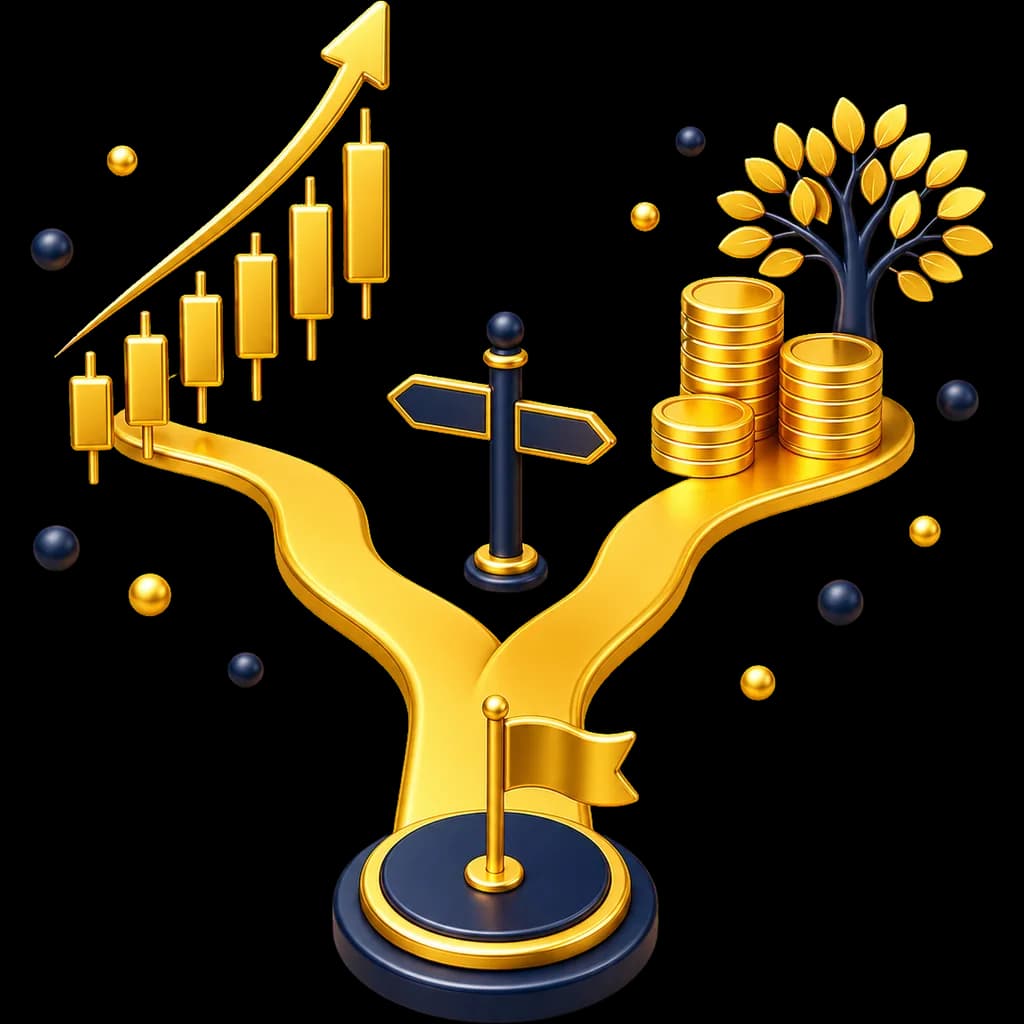
Two paths: trading or investing
The same market, but two completely different ways of using it. Neither one is "better" — it depends on how much time you have, how much capital you have, and what kind of person you are. This is the most important part of the page, so let's take it slowly.
Investing means buying a real asset and holding it for a long time — years, sometimes decades — hoping its value gradually rises. For example, you buy real shares of a company and become, for your small slice, a co-owner of it. You earn in two ways: if the price rises and you sell for more, and sometimes through dividends — a share of the company's profit, paid out periodically to shareholders simply because they hold the shares. With investing you earn only if the price rises, you work only with your own money, and you usually need a larger account, because you're waiting for slow growth over years, not a quick gain.
Seen this way, investing is closer to a passive or semi-passive income — the way financially educated people put their money to work, and usually the way people who've managed to build up some wealth do it too. You're not glued to a screen; you set money aside regularly and let time do the work.
A small example with Apple. Same company, two paths. As an investor, you buy real Apple (AAPL) shares — you become a shareholder, hold them for years, and can also receive dividends. As a trader, you open a CFD on Apple and can profit whether the price goes up or down, without owning a single share. Same company, two completely different ways of being in it.
Trading means buying and selling often, over short periods — from a few minutes to a few weeks — to catch price movements. Here a big difference appears: you can profit whether the price rises or falls. That's possible because in trading you often work with CFDs. A CFD (contract for difference) is an instrument through which you track the price of an asset — a currency, gold, oil, a stock market index — without actually owning the asset; you gain or lose the price difference, regardless of direction.
Unlike investing, trading is more like a profession: it demands presence, attention, and cool-headed decisions every day you're in the market. Some people genuinely do it as a career, others treat it as an occasional activity — but in both cases it has to be learned, like any profession.
Trading also brings in leverage: a mechanism that lets you open a position larger than the money you have in your account. It sounds appealing, but it has a side every beginner needs to see clearly: leverage amplifies gains and losses to the same degree. With leverage you can win more, but you can also lose more than you put on the table. That's why trading CFDs with leverage is considered a high-risk instrument. We're not saying this to scare you, but so you start out with realistic expectations.
The table below puts the two paths side by side, row by row:
Terms like ETF or bond will be explained along the way, on their dedicated pages. For now, remember the basic idea: trading is fast and active, with higher risk and possible leverage; investing is slow and patient, using only your own money, but it usually requires a more substantial account.
What you need to get started
Whatever path you choose, the starting point looks about the same. There are four things, in order. Each has its own more detailed page — here we're just putting them together for you.
A regulated broker
The firm through which you reach the market. "Regulated" means overseen by a serious authority — your money and your interests are protected. How to choose a broker
A demo account
An account with virtual money, where you practice with zero risk. This is where you make your first mistakes for free, until you get the hang of it. About platforms
Basic education
First you understand what you're buying and how it works, only then do you put in real money. No important step without having understood it. Financial education
A plan and risk rules
How much you're willing to risk, when you enter, when you exit — written down in advance, with a clear head, not decided on the spot, under emotion. Strategies
Is it legal in Moldova?
Yes — through regulated brokers.
For a person in the Republic of Moldova, it's legal to invest and trade through regulated brokers.
Law no. 177/2025, in effect since July 2025, bans binary options and restricts the aggressive promotion of leveraged products (such as CFDs) to people who are not professional clients. These rules, however, target the firms that promote and distribute such products in Moldova — not the ordinary client. The CNPF, the supervisory authority, has publicly stated that the law does not limit people's right to access regulated platforms on their own.
Keep two practical things in mind: binary options are banned, so stay away from them; and the broker you choose must be regulated by a serious authority (CNPF, ESMA, FCA, and similar), which you can verify. The full details — registers, fees, what's allowed and what isn't — are here: Legal trading in the Republic of Moldova
Myths about the stock market
There are a few ideas that circulate often and stop many people before they even start. Let's go through them one by one and set the record straight.
If you jump in without understanding anything and just press buttons at random, yes, it resembles gambling. But done with method, analysis, and clear risk rules, a trade is a reasoned decision about a price direction — not a roll of the dice.
How much you put in at the start depends on how much you can afford to risk without wrecking your life. You can practice for months on a demo account, with virtual money, before you risk a single real cent.
Every professional was once exactly where you are now. The difference isn't some innate talent, but education, practice, and the patience to learn step by step.
Through regulated brokers, it's perfectly legal and supervised. What's actually banned (such as binary options) is clearly defined by law — and we don't work with anything like that.
Where to go from here
Now you have the map. You know what the stock market is, you see the difference between the two paths, and you understand what you need to get started. All that's left is to choose your direction and continue with the right guide.
I want to become a trader
For those who want a faster-paced activity and are willing to dedicate time and attention to it. The guide walks you through it step by step: broker, demo account, platform, your first trade on demo, and, when you're ready, the move to real money.
From zero to traderI want to invest
For those who want to put their money to work over the long term, without watching the market every day. The guide shows you how to start: stocks and ETFs, your first portfolio, and the calm mindset of an investor.
Start investingFrequently asked questions
Where do I start if I know absolutely nothing?
Start with basic education, then a demo account. First you understand what you're buying and how it works, then you practice risk-free with virtual money, and only after that, if you want, do you move on to small real amounts.
How much money do I need to get started?
There's no single "correct" amount that applies to everyone. It depends on how much you can afford to risk without affecting your day-to-day life. On demo, you can start with zero real money. Also keep in mind that long-term investing usually requires a larger account than trading.
Trading or investing for a beginner?
It depends on your time, money, and personality. Investing requires less time day to day and a lot of patience, but usually a larger account. Trading requires attention and discipline every day, can start with a smaller account, but comes with higher risk. The table in chapter 02 will help you see yourself more clearly in one of them.
Is it dangerous?
Any placement in the stock market involves risk — you can lose money, and with leveraged trading you can lose it quickly. Risk never disappears completely, but it can be kept under control: through education, clear rules, and amounts you can afford to lose.
Want to start with guidance?
If you'd rather not go it alone at the start, a consultation shortens your path and shows you exactly where to begin.